
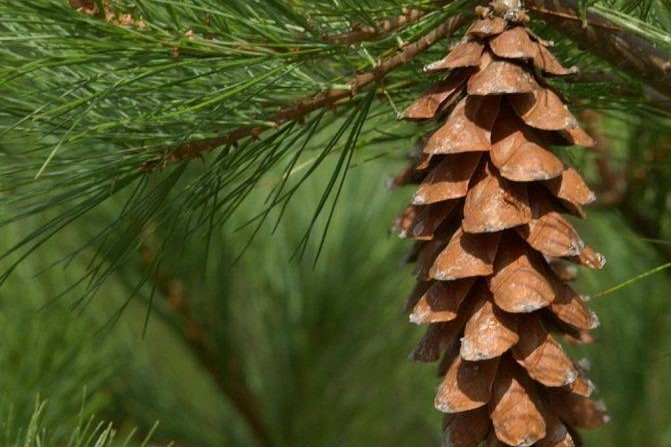
No question makes me roll my eyes more than one that starts with, “I have a pine in my yard.” Pine trees are evergreen trees. That does not mean that all evergreen trees are pine trees. Identifying evergreen trees is great first step in understanding the differences.
It seems like an innocent enough statement, and it is. My wife always tells me I get a little condescending when someone starts a plant question with pine. I know that at one point in time I didn’t know the difference between any evergreen either.
When it comes right down to it, most people don’t think about plants as much as I—or other plant people—do. But evergreens are a very diverse group of plants, and if you get to know them a little, you may find yourself wanting to learn more.

What Is an Evergreen?
An evergreen is a woody plant that stays green throughout the year, even through its dormant period.
All of the evergreen plants I’ll talk about in this article are conifers. Conifers produce cones (or strobili, the fancy botanical term for cones).
Just to make things slightly confusing:
- Not all conifers are evergreens.
- Not all evergreens are conifers.
And one more thing before we move on: just like not all evergreen conifers are pines, not all cones are pine cones—unless they actually come from a pine tree.

Latin Names vs. Common Names
I’ll try to keep this article as straightforward as possible. But if you’re interested in plants and want to talk about them with other plant people, learning the Latin names can save a lot of confusion.
Common names aren’t always very “common,” and a single plant can have several different ones. One person might call a tree a yellow swamp oak, while another might call the same plant a birch. Neither person is necessarily wrong, but unless they’re standing in front of the same tree, it can be hard to know they’re talking about the same plant.
Latin names remove the ambiguity—and honestly, some of them are just fun to say.
One of my favorites is:
Pinus densiflora ‘Oculus-draconis’

It’s a really cool variegated pine.
Identifying Evergreen Trees
Pinus (Pines)
When I first started learning about woody plants, I really didn’t like pines. They seemed boring. They don’t change color. They don’t flower. Just… blah.
But if the only pine tree you’ve ever noticed is the Eastern White Pine (Pinus strobus), you’re not getting the full picture of the genus.
One species in particular—Pinus longaeva, the Great Basin bristlecone pine—is the oldest living non-clonal organism on the planet, approaching 5,000 years old.

Pines are actually one of the easiest evergreen genera to identify. Their needles grow in bundles called fascicles.
Depending on the species, pines may have:
- 2 needles per fascicle
- 3 needles per fascicle
- 5 needles per fascicle
There’s really no other evergreen that looks quite like a pine. If you take the time to look at the tree’s shape and its needles, you can often identify a pine from a distance.
Abies (Fir)
Another type of evergreen is the fir.
Firs can be identified by their short, single needles. If you pull a needle off a fir branch, it leaves behind a small round scar where it was attached.
Another helpful clue: fir cones grow upright. Instead of hanging down like pine or spruce cones, they point up toward the sky.
Most fir trees also have a naturally conical shape. So if you see a perfectly conical tree in the wild (not one that’s been trimmed or shaped), chances are it’s not a pine.

Picea (Spruce)
Spruce trees are some of my favorites—mostly because of Picea abies, the Norway spruce.
It’s one of the easiest spruce trees to identify because of its pendulous secondary branches.
And honestly, I think I just like saying pendulous secondary branches.
Like fir, spruce trees have single needles, but they attach differently. When you pull off a spruce needle, it leaves behind a sharp little peg, which gives the twig a rough feel.
Spruce needles are also noticeably sharp, and their cones hang downward.
If you’re trying to tell a spruce from a fir, look for:
- Sharp needles
- Cones that hang downward
- Slightly more spacing between the needles

Chamaecyparis (False Cypress)
False cypress is another evergreen that’s fairly easy to recognize.
Instead of needles, Chamaecyparis has scale-like foliage, which looks very different from pine, fir, or spruce.
In landscaping, false cypress is often used more as a shrub than a tree.
One of the most overused examples—and another Latin name I love saying—is:
Chamaecyparis pisifera ‘Filifera Aurea’

Commonly known as Gold Mop False Cypress, it’s a slow-growing shrub with shaggy, mop-like yellow foliage.
Cedrus (True Cedars)
Now let’s clear up one of the more confusing plant name situations.
Cedrus is the genus for what we call true cedars.
But here on the East Coast of the United States, when people say red cedar, they’re usually talking about Eastern Red Cedar, which is actually a juniper:
Juniperus virginiana
This is one of those cases where common names create a lot of confusion.
True cedars are some of my favorite trees. Part of that is because I never saw one until I was in college—and before that I thought Eastern Red Cedar was a cedar.
But mostly it’s because they’re large, graceful trees.
One that landscape architects love to plant (sometimes a little too close to houses) is:
Cedrus atlantica ‘Glauca’

The Blue Atlas Cedar
With its striking blue color, it’s often used as a specimen tree—but it can grow up to 100 feet tall and 60 feet wide, which makes it a questionable choice right next to someone’s house.
There Are Many More…
This is by no means a complete list of evergreen trees. These are just a few you’re likely to see around you to start your journey into identifying evergreen trees.
But listing every evergreen wasn’t really my goal.
My hope from this short lecture is simply that the next time you see an evergreen, you take a closer look.
Don’t just see a green—or blue, or yellow—blob in your peripheral vision.
Look at the needles.
Look at the cones.
Look at the shape of the tree.
Start noticing the clues plants give you.
Or… you can always cheat and use a plant ID app.
They work pretty well.
I hope this was helpful in explaining the complex layers of identifying evergreen trees and encourages you to learn more and get curious about these special trees.
If you’re new to this, start with my introduction to horticulture article and what to expect from my articles.